Talent Attraction and Retention
We maintain fair, competitive, and locally appropriate compensation practices. Compensation levels are regularly assessed against external market benchmarks and local living wage conditions to ensure alignment with prevailing standards. We also apply the principle of equal pay for work of equal value and review our compensation structures to identify and address potential gender-related disparities.
84.96% of overall retention rate
We calibrate employee lifecycle processes through insights from workforce data, the Global Employee Engagement Survey, employee feedback, and focus group discussions. This approach is supported by data analytics and ongoing workforce trend monitoring to identify priority areas and appropriate talent retention actions, supporting workforce stability and long-term organizational resilience.
Note: Turnover rates have been recalculated and restated using a more stringent definition and methodology.
We use workforce data and strategic workforce planning to support talent attraction and retention. By reviewing existing employee capabilities, anticipating future talent requirements, and identifying skill gaps, we ensure that talent management remains aligned with business objectives, workforce sustainability, and long-term performance.
Our retention approach is supported by targeted initiatives, including career development, succession planning, learning opportunities, performance management, employee benefits, flexible working arrangements, wellness initiatives, and regular employee engagement and feedback. These initiatives are implemented across businesses and locations according to workforce needs and organizational priorities.
We continue to strengthen our global HR processes and people capabilities in line with our strategic long-term priorities:
- Human Resources Information System (HRIS): A global human capital management platform supporting consistent goal setting, performance monitoring, transparent reviews, and standardized talent management across global operations. Appraisal results also inform performance-linked compensation.
- Talent Acquisition and Succession Planning: Our succession planning framework covers senior, middle, and site-level leadership and is supported by continuous development, on-the-job experience, targeted learning interventions, and regular performance reviews.
- Leadership and Capability Development: Leadership capabilities are strengthened through structured training, digital learning, mentoring, and development programs to build a strong and future-ready leadership pipeline.
- Global Employee Engagement and Dialogue: The Global Employee Engagement (GEE) Survey is conducted every two years across regions and business units to assess employee engagement and well-being. Survey insights inform continuous improvement actions and HR initiatives, while ongoing dialogue is supported through townhall meetings, focus groups, HR Connect sessions, leadership updates, and open forums to promote transparency, trust, and sustained engagement.
Workforce Engagement
Our Employee Engagement approach helps us understand how we can better engage our workforce and create a workplace of choice. Throughout our employees’ journeys with Indorama Ventures, we consider different touchpoints to identify and enable appropriate actions, with the Global Employee Engagement Survey serving as one of the key mechanisms.
Maintain an Employee Net Promoter Score (NPS)
≥ 70% starting from 2024.
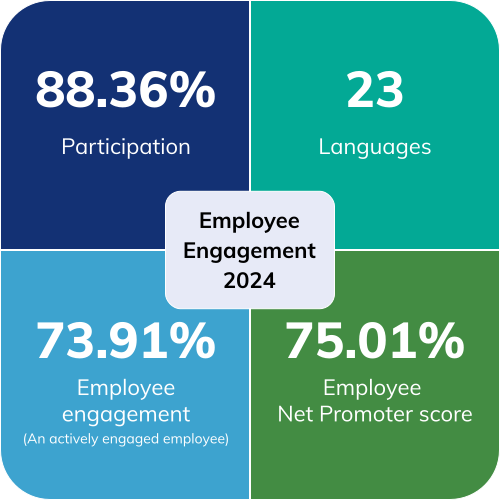
The Global Employee Engagement survey is carried out every two years and measures:
- Survey Participation: 88.36%
- Employee Engagement: 73.91% (actively engaged employees)
- Employee Net Promoter Score: 75.01%
- Key Engagement Drivers:
- Objectives and aspirations: 74.69%
- Accountabilities and collaborations: 79.46%
- People manager capabilities and interactions: 74.03%
- Performance management and recognition: 62.88%
- Leadership 73.35%
- The GEE Survey assesses engagement across multiple dimensions of well-being, including job satisfaction, purpose, well-being, and work-life balance.
Survey insights are used to monitor trends in employee well-being over time and inform continuous improvement actions at both global and site levels, supported by management review. These insights further inform global and local HR initiatives, including enhancements in performance management, job evaluation and salary benchmarking, communication practices, leadership development, and employee recognition.
To ensure effective follow-up, operating sites implement a structured process following each survey cycle, including focus group discussions, data validation, and the prioritization of improvement areas. We also maintain regular employee engagement through townhall meetings, HR Connect sessions, leadership updates, and open forums, promoting transparency, accountability, trust, and sustained engagement across the organization.
Enhancing Well-Being and Work-Life Balance
Employee well-being is a key driver of organizational resilience, performance, and long-term sustainability. Our approach integrates physical, emotional, mental, and social well-being through targeted programs delivered via a structured framework, with clear roles, consistent application across operations, and ongoing monitoring to ensure alignment with employee needs and organizational priorities.
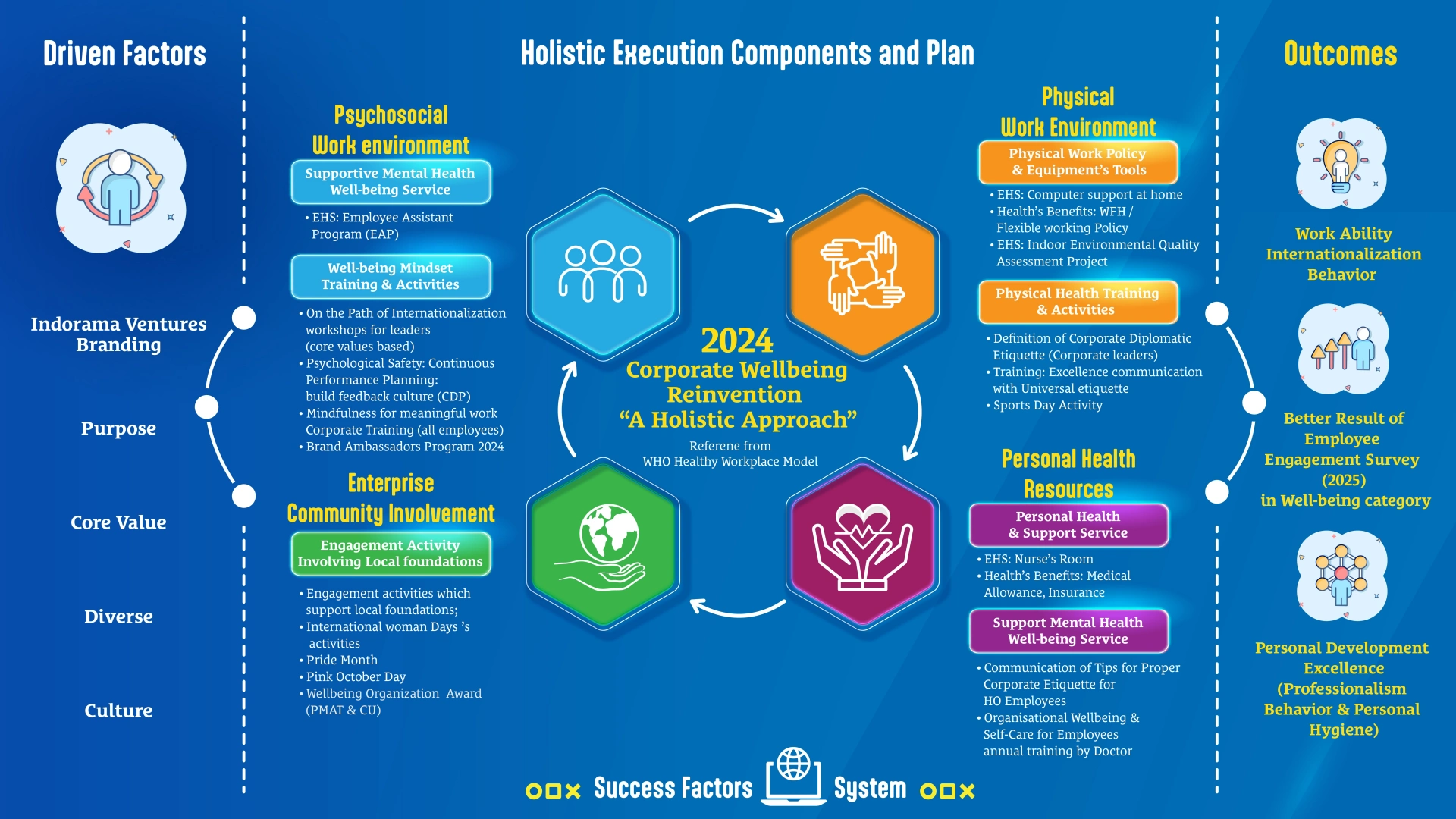
We build on our Corporate Well-being Reinvention Framework, a structured approach established to enhance employee well-being across physical, emotional, mental, and social dimensions through integrated programs and continuous improvement practices, with a continued focus on flexibility, inclusion, and personal fulfillment at work.
To support work-life balance, we provide structured working-hour arrangements, paid annual leave, and flexible working options, including part-time working arrangements where appropriate. We also encourage employees to make full use of their paid time off to support rest and long-term well-being.
Employee Benefits
At Indorama Ventures, we provide a comprehensive benefits program designed to reflect our commitment to employee well-being, inclusivity, and long-term workforce sustainability. The program supports work-life balance and family care while offering flexible benefits packages that cater to the diverse needs of employees, allowing for customization where possible.
Paid parental leave
Primary and non-primary caregivers are entitled to paid parental leave benefits. In Thailand, for instance, primary caregivers receive up to 60 days of paid leave, while non-primary caregivers receive up to 2 weeks.
Extended care leave
Employees may take sick leave (up to 30 days with pay) or funeral leave (up to five days) to care for loved ones, including spouses, children, and parents, with a physical or mental health condition.
Newborn allowance
A childbirth allowance is provided for every birth.
Childcare contributions
Scholarships are available for the children of employees, along with childbirth allowances for spouses and financial support for education.
Family medical support
Medical allowance reimbursement covers employees, spouses, children, and parents.
Group health insurance
Benefits are available to employees and extendable to spouses and children.
Workplace well-being and health
Wellness initiatives and annual physical checkups support employee health and well-being.
Sports and health initiatives
Local sports events promote physical well-being and team spirit among employees.